
Choosing the right skincare products becomes infinitely easier once you know your true skin type. Yet many people guess wrong, leading to frustration, wasted money, and skin problems that worsen instead of improving. You might think you have oily skin when you’re actually dehydrated, or assume your skin is sensitive when it’s simply reacting to the wrong products.
Understanding your skin type is the foundation of an effective skincare routine. This comprehensive guide will help you accurately identify whether you have oily, dry, combination, or sensitive skin—and what that means for your daily care routine. We’ll also cover common misconceptions and explain why your skin type might change over time.
Why Knowing Your Skin Type Matters
Using products formulated for the wrong skin type can create or worsen skin issues. If you have dry skin but use mattifying products designed for oily skin, you’ll strip away essential moisture and damage your skin barrier. Conversely, using heavy creams on oily skin can clog pores and trigger breakouts.
The right products work with your skin’s natural characteristics rather than against them. When you match your routine to your actual skin type, you’ll notice:
- Fewer breakouts and less congestion
- Better product absorption and effectiveness
- Reduced irritation and sensitivity
- Improved texture and overall appearance
- Money saved by avoiding products that don’t work
Think of determining your skin type as getting a proper diagnosis before treatment. You wouldn’t take random medication without knowing what’s wrong—your skin deserves the same thoughtful approach.
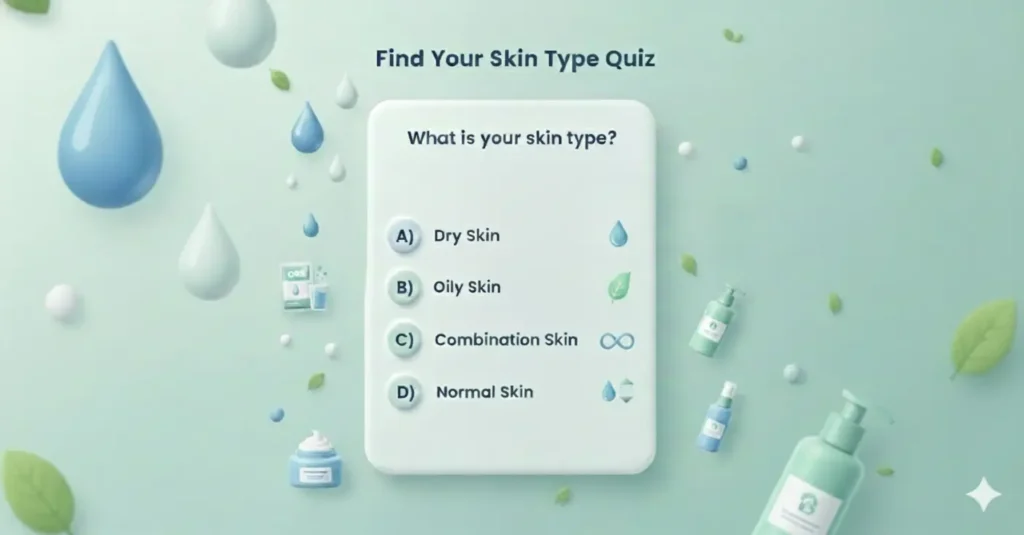
The Four Main Skin Types Explained
Before we dive into testing methods, let’s clarify what defines each skin type. These categories describe your skin’s natural oil production and behavior without any products applied.
Oily Skin
Oily skin produces excess sebum throughout the day, especially in the T-zone (forehead, nose, and chin). This skin type often has visibly enlarged pores, a shiny appearance by midday, and a tendency toward blackheads and breakouts. The upside? Oily skin typically ages slower due to natural moisture retention.
Dry Skin
Dry skin produces insufficient oil to maintain adequate moisture levels. It may feel tight, especially after cleansing, and can appear dull or flaky. Fine lines are more visible, and the skin may develop rough patches or feel uncomfortable. Dry skin needs both oil and water replenishment.
Combination Skin
Combination skin exhibits characteristics of both oily and dry types simultaneously. The T-zone produces excess oil while cheeks remain normal to dry. This is actually the most common skin type, though many people mistakenly think they must be purely oily or dry.
Sensitive Skin
Sensitive skin isn’t technically a skin type but rather a condition that can affect any type. It reacts easily to products, weather, or stress with redness, burning, stinging, or itching. Sensitive skin often has a compromised barrier and requires gentle, fragrance-free formulations.
The Bare-Faced Test (Most Accurate Method)
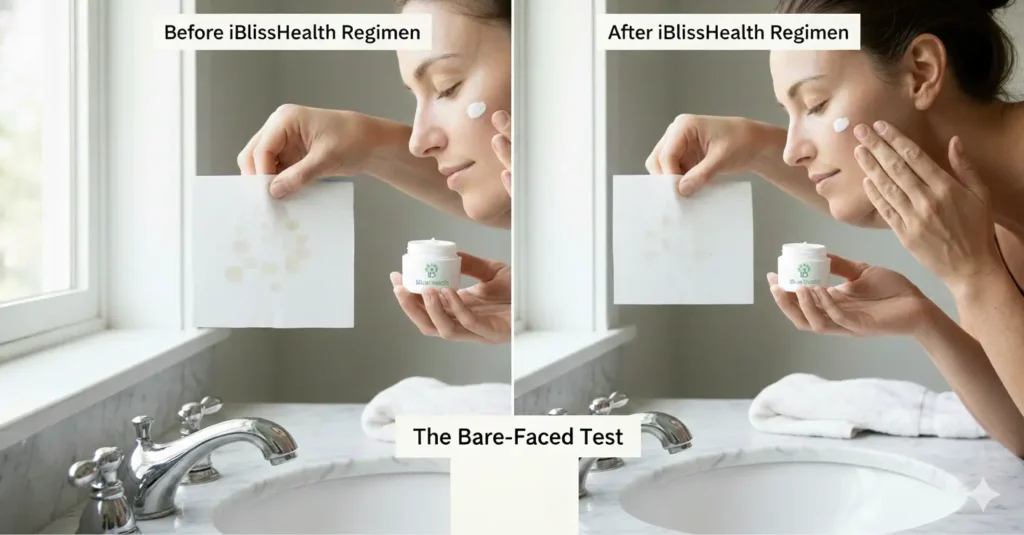
This simple at-home test reveals your skin’s natural behavior without interference from products. You’ll need to dedicate one morning to this assessment.
How to Perform the Test:
Start the evening before by washing your face with a gentle cleanser. Pat dry and don’t apply any products—no toner, serum, moisturizer, or treatment. Go to bed with your completely bare face.
When you wake up, examine your skin before washing or touching it:
- Press a tissue to different areas of your face (forehead, cheeks, nose, chin)
- Observe how your skin looks and feels
- Take note of any tightness, oiliness, or normal sensation
Interpreting Your Results:
You Have Oily Skin If:
- Oil blots appear on the tissue from most areas of your face
- Your entire face looks shiny or greasy
- Your skin feels slick to the touch
- Pores are visible, especially on nose and cheeks
You Have Dry Skin If:
- No oil transfers to the tissue
- Your skin feels tight or uncomfortable
- You notice flakiness or rough texture
- Your face looks dull or lacks radiance
You Have Combination Skin If:
- Oil appears only on your T-zone (forehead, nose, chin)
- Your cheeks feel normal or slightly dry
- Different areas require different care approaches
You Have Sensitive Skin If:
- Your skin shows redness or irritation
- Going product-free caused itching or burning
- You see visible capillaries or flushing
- Your skin reacts to temperature changes
The Daytime Observation Method
If you can’t do the overnight test, observe your skin’s behavior 2-3 hours after your morning skincare routine. This method is less accurate but still informative.
Cleanse and moisturize normally in the morning, then wait until mid-morning or early afternoon. Without touching up or blotting:
- Check your face in natural light
- Note which areas look shiny versus matte
- Feel for texture differences across your face
- Observe how your makeup wears (if applicable)
Oily skin will show breakthrough shine, especially in the T-zone. Dry skin might show makeup settling into fine lines or flaky patches. Combination skin displays the mixed characteristics we’ve discussed.
Common Skin Type Misconceptions
“My skin is oily, so I don’t need moisturizer”
Wrong. Oily skin still needs hydration. In fact, skipping moisturizer can trigger even more oil production as your skin compensates for dehydration. Choose a lightweight, oil-free gel moisturizer instead of heavy creams.
“Dry skin and dehydrated skin are the same thing”
Not quite. Dry skin lacks oil (lipids), while dehydrated skin lacks water. You can have oily but dehydrated skin, which confuses many people. Dehydration is temporary and fixable with hydrating ingredients like hyaluronic acid, while true dry skin is a permanent type requiring oil-based care.
“Sensitive skin is a permanent condition I can’t change”
Sensitivity often results from a damaged moisture barrier or using harsh products. While some people have naturally reactive skin, many can reduce sensitivity by repairing their barrier with gentle, fragrance-free products and avoiding over-exfoliation.
“My skin type never changes”
Your skin type can shift due to age, hormones, climate, medications, and lifestyle factors. Many people have oilier skin in their teens and twenties, then notice increasing dryness in their thirties and beyond. Pregnancy, menopause, and hormonal changes also affect oil production.
Additional Factors That Affect Skin Behavior
Beyond your baseline skin type, several factors influence how your skin looks and feels:
Climate and Weather
Humidity increases oiliness while dry air exacerbates dryness. You might need different products in summer versus winter, or when traveling to different climates. This doesn’t change your underlying skin type but requires seasonal adjustments.
Age and Hormones
Teenage skin tends toward oiliness due to hormonal surges, while mature skin often becomes drier as oil production naturally decreases. Hormonal fluctuations during menstrual cycles, pregnancy, or menopause significantly impact skin behavior.
Medications and Health Conditions
Certain medications (like isotretinoin for acne) drastically reduce oil production. Health conditions including thyroid disorders, diabetes, and autoimmune diseases can affect your skin. Always consider these factors when assessing your type.
Product Overload
Using too many active ingredients or harsh products can temporarily alter your skin’s behavior. If your skin suddenly becomes sensitive or reactive, strip your routine back to basics before deciding your “new” skin type.
Matching Products to Your Skin Type
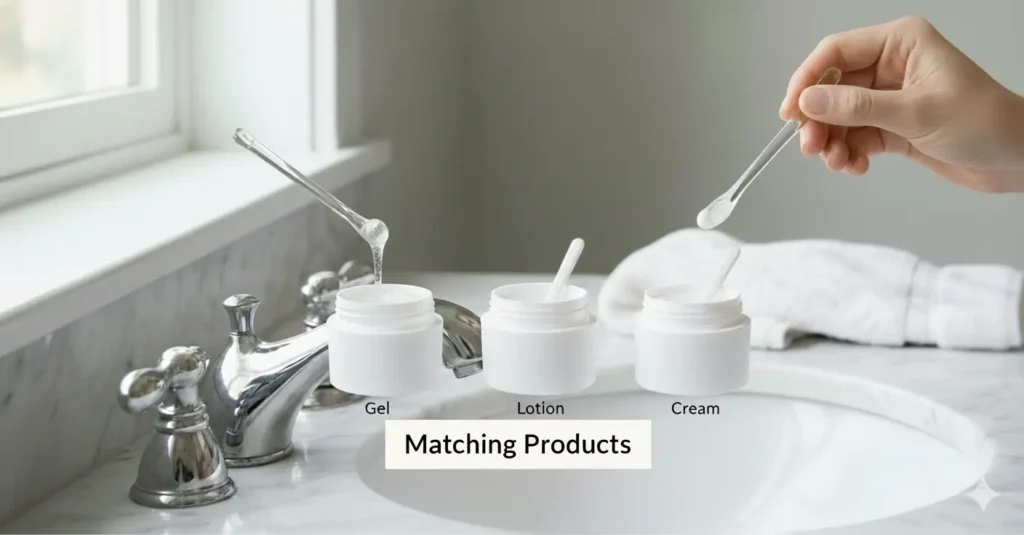
Once you’ve identified your skin type, here’s how to choose appropriate products:
For Oily Skin:
- Cleansers: Gel or foaming formulas with salicylic acid
- Moisturizers: Oil-free, lightweight gel or gel-cream textures
- Serums: Niacinamide to regulate oil production
- Sunscreen: Mattifying, non-comedogenic formulas
- Avoid: Heavy creams, coconut oil, thick balms
For Dry Skin:
- Cleansers: Cream or milk cleansers, avoid foaming
- Moisturizers: Rich creams with ceramides and fatty acids
- Serums: Hyaluronic acid for hydration, facial oils for nourishment
- Sunscreen: Moisturizing SPF formulas
- Avoid: Alcohol-based toners, harsh exfoliants, mattifying products
For Combination Skin:
- Cleansers: Gentle gel cleansers that balance without stripping
- Moisturizers: Lightweight lotion or gel-cream
- Serums: Multi-tasking formulas like niacinamide + hyaluronic acid
- Sunscreen: Universal non-greasy formulas
- Strategy: You may need to spot-treat different zones differently
For Sensitive Skin:
- Cleansers: Fragrance-free, gentle, pH-balanced formulas
- Moisturizers: Minimal ingredient lists with ceramides
- Serums: Soothing ingredients like centella or azelaic acid
- Sunscreen: Mineral/physical sunscreens (zinc oxide)
- Avoid: Fragrances, essential oils, harsh actives, alcohol
The Skin Type Chart: Quick Reference
Create a quick reference for yourself:
Morning routine after cleansing, your skin feels:
- Tight and uncomfortable → Dry
- Comfortable and balanced → Normal
- Slick within an hour → Oily
- Tight in some areas, oily in others → Combination
By midday without blotting:
- Entire face is shiny → Oily
- Face looks the same as morning → Dry or Normal
- Only T-zone is shiny → Combination
Your pores look:
- Barely visible → Dry or Normal
- Enlarged on nose and cheeks → Oily
- Enlarged in T-zone only → Combination
You experience breakouts:
- Rarely → Dry or Normal
- Frequently, especially blackheads → Oily
- Sometimes, mainly in T-zone → Combination
- When using certain products → Sensitive
When to Reassess Your Skin Type
Reassess your skin type whenever you experience:
- Significant life changes (pregnancy, menopause, new medications)
- Moving to a dramatically different climate
- Persistent skin issues despite a consistent routine
- Seasonal transitions (especially summer to winter)
- Every 2-3 years as a general check-in
Your skin is dynamic, not static. What worked perfectly last year might need adjustments now. Pay attention to how your skin responds and be willing to adapt your routine accordingly.
Professional Assessment Options
While at-home tests work well for most people, consider professional assessment if:
- You’ve tried everything but still experience persistent issues
- You suspect an underlying skin condition
- You’re investing in expensive treatments and want expert guidance
- You have skin that behaves inconsistently or unpredictably
Dermatologists and licensed estheticians use advanced tools like moisture meters, sebum measurement devices, and detailed skin analysis to provide accurate assessment. This is especially valuable for complex cases or when multiple conditions coexist.
Conclusion: Your Skin Type Roadmap
Determining your skin type is not about fitting into a rigid category—it’s about understanding your skin’s natural tendencies so you can care for it effectively. Most people have characteristics of multiple types, and that’s completely normal.
Use the bare-faced test as your primary assessment method, observe how your skin behaves throughout the day, and pay attention to seasonal changes. Remember that your skin type may evolve over time, so stay flexible and willing to adjust your routine as needed.
Now that you know your skin type, you can confidently select products and build a routine that truly works for your unique skin. Your skincare journey just became a lot more targeted and effective.
Frequently Asked Questions
Can I have different skin types on different parts of my face?
Yes, that’s exactly what combination skin is. Most people have some variation across their face, with the T-zone behaving differently than the cheeks. This is why spot-treating different areas with appropriate products often works better than using the same product everywhere.
How do I know if my skin is sensitive or just reacting to bad products?
True sensitive skin consistently reacts to multiple products, temperature changes, and environmental factors. If your skin only reacts to specific ingredients or harsh products, you likely have normal skin that’s been temporarily irritated. Try eliminating potential irritants and rebuilding your barrier with gentle products for 4-6 weeks.
My skin is oily but still feels dry—what does that mean?
You likely have dehydrated skin, not truly dry skin. Dehydration is a skin condition (lack of water) rather than a type (lack of oil). Use lightweight hydrating products with hyaluronic acid and avoid harsh, stripping cleansers that worsen the problem by triggering more oil production.
Does acne mean I automatically have oily skin?
Not necessarily. While oily skin is more prone to acne, you can experience breakouts with any skin type due to hormones, bacteria, clogged pores, or product reactions. Dry skin can develop acne too. Focus on treating the acne appropriately for your underlying skin type rather than assuming all acne requires oil-control products.
Should I use different products in different seasons even if my skin type stays the same?
Yes, seasonal adjustments are smart. Your skin type remains constant, but environmental factors change how it behaves. You might need a richer moisturizer in winter or a lighter one in humid summer months. The key is adjusting product textures and heaviness while maintaining your skin type-appropriate ingredient focus.